Harold's relationship with the purple crayon
Harold and the Purple CrayonHarold's relationship with the purple crayon joins practical reliance to imaginative agency: the crayon travels with him as he tries to orient himself, and his drawing turns danger into a route onward. It does not simply guarantee that he will find his way. His path fails to carry him toward a destination, and the many windows he makes do not identify Harold's bedroom; resolution comes when he remembers how the bedroom relates to the Moon. The crayon is therefore both the means by which Harold changes his surroundings and an object whose usefulness has limits.
A tool taken on the walk
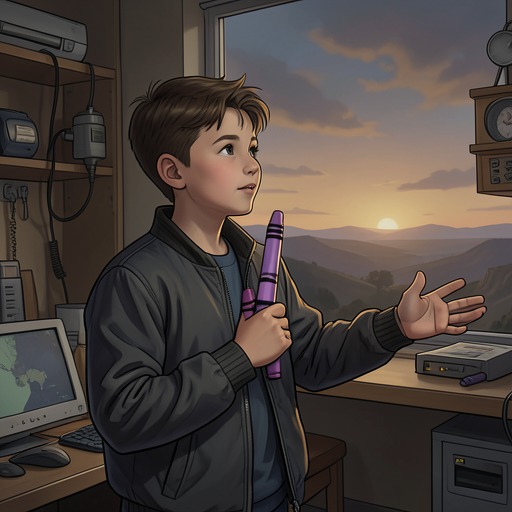
Harold takes the purple crayon with him when he sets out. Before that, he has made a long, straight path so that he will not get lost. The pairing gives the crayon an immediate practical association: Harold is not only carrying it, but moving through a world in which drawing can supply a route. The path is meant to prevent disorientation, turning a walk into a line with a clear direction. Yet Harold does not seem to be getting anywhere on it. The intended safeguard and the disappointing result sit side by side: having a drawn path does not, by itself, ensure progress.
That failure makes the crayon's role more complex than a simple instrument of control. Harold leaves the path for a short cut, and his journey continues through situations in which he must work out where he is and what to do. The crayon accompanies him, but the story does not present it as a map that already contains the right answer. Its value lies instead in the possibility of making: Harold can respond to the immediate predicament by bringing a new feature into being. The distinction matters throughout his adventures. A line can set him moving without ensuring that he is closer to home; a creation can solve one urgent problem without settling the larger question of where his bedroom is.
The crayon in fear and danger
The encounter with the frightening dragon gives the relationship a bodily, vulnerable detail. Harold is frightened enough to back away, and his hand holding the purple crayon shakes. The crayon remains in that hand even as fear disrupts his steadiness. It is not depicted as an independent protector, nor does the danger disappear simply because Harold has brought it. Instead, the scene places his fear and the instrument together: the hand that holds the means of drawing is also the hand that trembles.
Later, when Harold discovers that there is no other side to the mountain and that he is falling through thin air, the narration again emphasizes what he has retained: his wits and the purple crayon. That pairing connects his capacity to think under pressure with the object he carries. He makes a balloon, grabs on to it, and adds a basket large enough to stand in. The sequence gives the crayon a consequential place in his survival: Harold answers the fall not by finding a ready-made escape, but by making one. His earlier fear at the dragon and his response to the fall are not identical tests. In the first, the shaking hand registers how exposed he feels; in the second, keeping both his wits and the crayon allows him to act.
Making possibilities, not certainty
The crayon's creative power is most clearly shown in the balloon episode, but the wider search for a way to orient himself defines its limits. Harold knows that a higher vantage point would let him see farther, so he decides to make the hill into a mountain. This decision ties drawing to an effort to gain perspective: the created landscape is not merely scenery but an attempted solution to the problem of locating himself. Yet the mountain leads to a fall rather than a final view of home. The crayon enables a chain of responses, not a guaranteed, straight-line return.
That distinction becomes especially clear when Harold makes buildings full of windows and then a whole city full of them. Despite the abundance, none of the windows is his, and he cannot think where it might be. The crayon can multiply possible places to look, but quantity does not produce recognition. The city stands in contrast to the early straight path: both represent attempts to organize a way through uncertainty, yet neither resolves the search. Harold's eventual clue is remembered rather than newly drawn. He recalls where his bedroom window was when there was a Moon and that it was always right around the Moon. The remembered relation supplies what the proliferating windows could not: a dependable orientation to Harold's bedroom.
The crayon's release
The ending changes the crayon's status without diminishing its importance. Once Harold reaches his bed, he gets in and draws up the covers. The purple crayon drops on the floor, and Harold drops off to sleep. Its fall is quiet and distinct from the earlier fall from the mountain: there, Harold holds on to the crayon while making an escape; here, he no longer needs to keep it in his hand. The object that accompanied his unsettled movement can be set aside when the search is over.
The sequence closes the relationship through a concrete gesture rather than an explanation. The crayon has remained present through a shaking hand, a dangerous descent, and the creation of a balloon; at the end, it is on the floor beside the bed while Harold sleeps. Its function has depended on the circumstances: it serves the journey when he must act, but the final return depends on remembering the Moon's relation to his bedroom window. The crayon is thus neither discarded as useless nor made into an all-solving guide. It is the instrument of Harold's imaginative responses, carried until he has found the place where he can stop using it.